

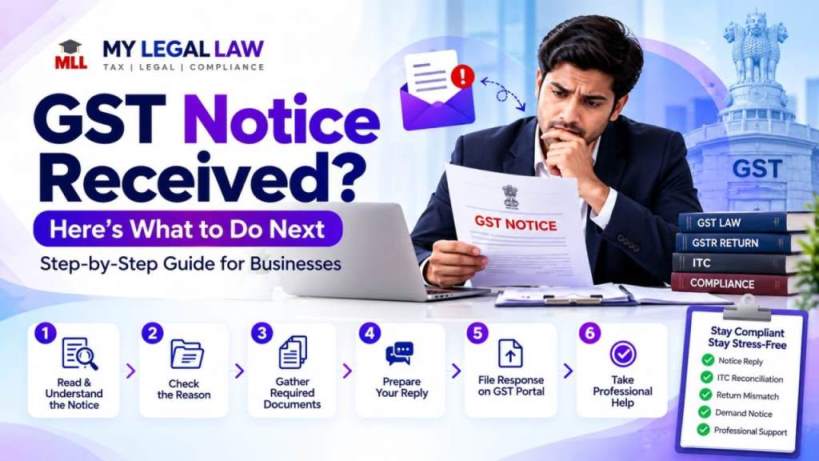
Opening an email or portal alert that says “GST Notice” is enough to make any business owner’s stomach drop. Take a breath. A GST notice isn’t automatically an accusation. Very often, the department just wants a clarification, a document, or an explanation for a mismatch in your records.
What matters is how you respond. Ignoring the notice is the one move that almost always makes things worse.
In this guide, we’ll walk through why GST notices are issued, what to do when you receive one, which documents to keep ready, the mistakes to avoid, and when it makes sense to call in a professional.
What Is a GST Notice?
A GST notice is an official communication from the GST Department to a registered taxpayer. It may ask you to explain a discrepancy, submit documents, or respond to a proposed tax demand or other action.
A typical notice will mention the reason it was issued, the tax period involved, a reference number, what action is expected, and the reply deadline. That’s why your first job is simple: read it carefully and understand exactly what is being asked.
Why Do Businesses Receive GST Notices?
There’s no single cause. These are the most common triggers.
Return mismatch. If the figures in your returns don’t line up, say your GSTR-1 shows one amount of taxable sales and your GSTR-3B shows another, the system may flag it. The cause is often innocent, like a timing difference or a missed amendment, but it needs a proper reconciliation.
ITC mismatch. Input Tax Credit is the area where businesses hear from the department most often. If the credit you claimed differs from what appears in your GSTR-2B or other records, you may be asked to explain. Purchase invoices and your purchase register become your best friends here.
Non-filing of returns. Missing a due date, or leaving returns pending for several periods, can invite a notice or further action. Filing pending returns promptly is usually the right first step.
Tax liability. The department may believe tax was short-paid, or that interest or penalty is due. Before accepting or disputing the figure, check their calculation against your books and returns.
Registration issues. Notices about verification, amendment, suspension, or proposed cancellation of registration deserve extra attention, because a poor response can affect your ability to operate.
Refund queries. If you’ve applied for a refund, the department may ask for additional documents or clarification before processing it.
What to Do After Receiving a GST Notice
Here’s a practical sequence you can follow.
1. Read the notice slowly
Note the notice type, reference number, issue date, tax period, the specific issue raised, the documents requested, and the reply deadline. Don’t start drafting until you’re clear on what’s being asked.
2. Check it against your own records
Compare the department’s points with your books of accounts, GST returns, sales and purchase records, ITC details, and tax payments. Many discrepancies turn out to be caused by credit notes, amendments, or timing differences.
3. Reconcile the numbers
A clean reconciliation is often the strongest part of a reply. Depending on the issue, it may look like this:
- Purchase side: Books → Purchase Register → GSTR-2B → GSTR-3B
- Sales side: Sales Register → GSTR-1 → GSTR-3B
When the department can see exactly where a difference came from, the conversation gets much easier.
4. Gather supporting documents
Collect everything relevant before you start writing, so your reply is complete the first time.
5. Draft a point-wise reply
Respond to each point in the notice, one by one. A vague, generic reply that doesn’t address the actual discrepancy rarely helps.
6. Submit on time and keep proof
Check the deadline in the notice and under the applicable GST provisions. Once you submit, save the acknowledgement or ARN, along with a full copy of your reply and attachments.
7. Keep watching the portal
Even after replying, keep checking the GST portal for hearing notices, orders, or further requests.
Documents You May Need
The exact list depends on the notice, but commonly required documents include:
- GST registration certificate
- GSTR-1, GSTR-3B, and GSTR-2B copies
- Sales and purchase registers
- Sales and purchase invoices
- Credit and debit notes
- E-way bills and e-invoices
- Bank statements
- Electronic cash and credit ledgers
- Tax payment challans
- Reconciliation statements
- Relevant agreements or other supporting papers
One tip: submit what’s relevant to the issue, not everything you have. A focused set of documents is easier to review and more convincing.
Common Mistakes to Avoid
- Ignoring the notice. This is the biggest and most costly mistake.
- Replying without checking your records. Never accept a discrepancy before verifying it.
- Sending a generic reply. Address the specific questions asked.
- Submitting incomplete documents. Gaps make it harder to prove your case.
- Missing the deadline. Late replies can complicate matters, depending on the proceeding.
- Giving inaccurate information. Closing the matter quickly isn’t worth submitting anything you can’t support.
What Happens If You Don’t Reply?
If you stay silent, the department can continue the proceedings on the basis of the information it already has. Depending on the case, this may lead to an order, a tax demand, interest, penalty, action on your GST registration, or simply a much harder path to fixing things later. Treat every GST notice as a compliance matter that deserves a timely response.
When Should You Get Professional Help?
Many simple notices can be handled in-house. But it’s wise to consult a GST professional when:
- The tax amount involved is significant
- There’s an ITC dispute
- You’ve received a Show Cause Notice
- Cancellation of your registration is proposed
- The notice alleges fraud or suppression
- Multiple tax periods are involved
- Your earlier explanation was rejected
- An order has already been passed
- You may need to file an appeal
A professional can help with notice analysis, reconciliation, documentation, drafting the reply, and follow-up.
Frequently Asked Questions
Is a GST notice a serious matter?
It should be taken seriously, but it doesn’t automatically mean you’ve violated the law. It needs to be reviewed and answered properly.
Can I reply to a GST notice myself?
Yes, in many cases. For complex matters involving large amounts, ITC disputes, or registration cancellation, professional help is advisable.
What if I disagree with the notice?
Explain your position clearly and back it up with records and documents. The right remedy depends on the stage of the proceedings.
How long do I have to reply?
It varies by notice type and the applicable provisions, so always check the deadline stated in your notice.
Can My Legal Law help with GST notices?
Yes. My Legal Law assists businesses with GST notice review, documentation, reconciliation, reply preparation, and ongoing GST compliance.